GFCI Outlet Replacement: What NJ Code Lets You DIY
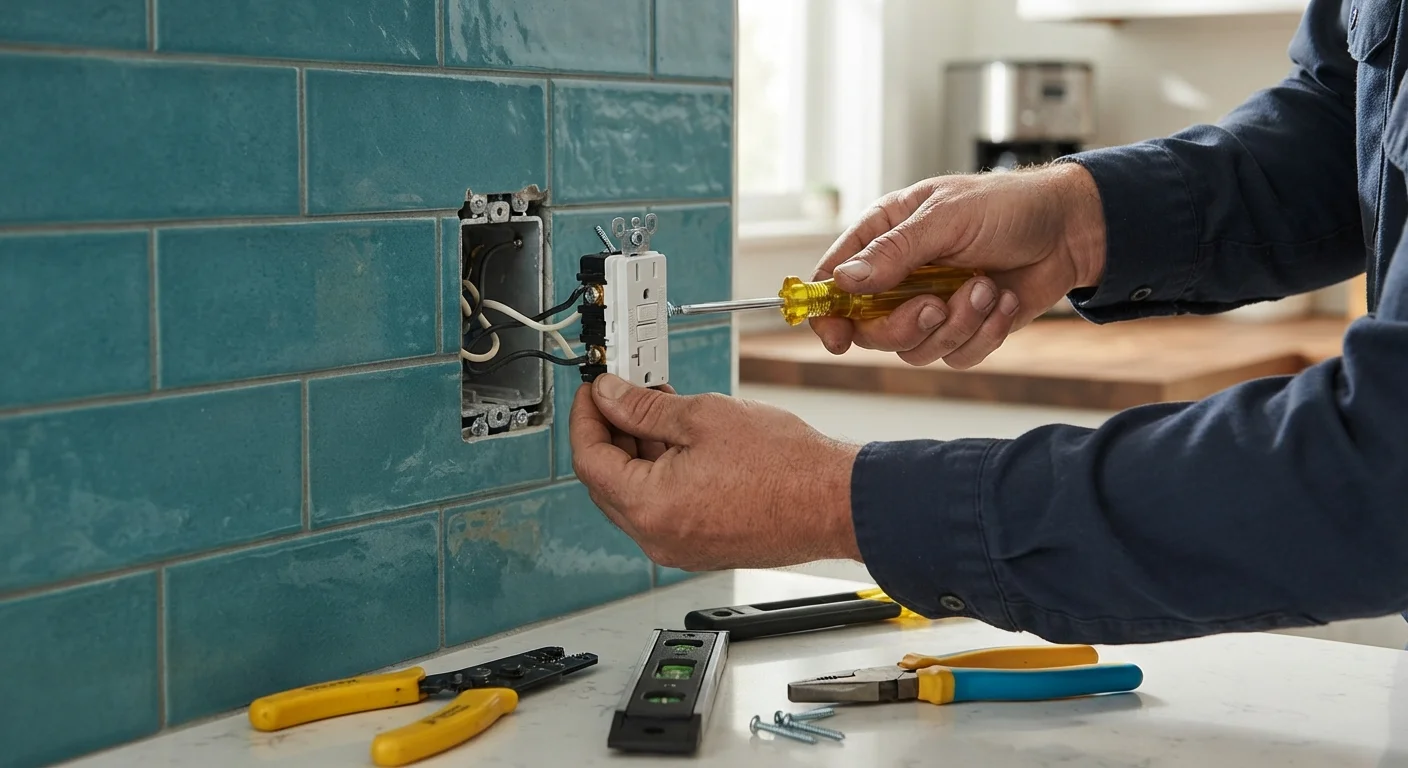
A GFCI receptacle costs about twenty dollars and takes fifteen minutes to change. That part homeowners usually get right. What they miss is the classification. New Jersey sorts the same physical job three different ways. Which way applies depends on the outlet you touch.
Get it wrong and the work is illegal, uninspected, and sitting in a wet location. Get it right and you have done a repair the state expressly allows you to do yourself.
Key Takeaways
- Swapping a failed GFCI for a similar GFCI is ordinary maintenance in New Jersey. No permit, no inspection, no license required.
- The exemption carries a condition. Receptacles in locations requiring GFCI protection, damp or wet locations, or tamper-resistant locations must comply with Section 406.4(D) of the electrical subcode.
- Installing five or fewer new outlets is minor work. That needs a permit and a licensed electrical contractor, even though it sounds small.
- The 2023 code widened kitchen coverage to all kitchen receptacles, not only those serving a countertop.
- Electrocutions in the United States fell roughly 80 percent between 1975 and 2020 as GFCI requirements expanded through the code.
The New Jersey Rule That Decides Everything
Most states leave this vague. New Jersey does not.
The Department of Community Affairs publishes a list splitting residential work into ordinary maintenance and minor work. Ordinary maintenance needs no permit at all. Minor work needs a permit, but a simplified one.
Under the electrical heading, the rule reads plainly. Receptacles, switches, or lighting fixtures that do not contain emergency battery packs may be replaced with a similar item. A dead GFCI replaced by a new GFCI is a similar item. You may do that yourself.
New outlets are a different animal. The installation of five or fewer outlets, where the existing circuits and service can support the load, is minor work. Minor work means a permit. It also means a contractor holding a license from the Board of Examiners of Electrical Contractors.
The line is replacement versus addition. Nothing else moves it.
Where GFCI Protection Is Actually Required
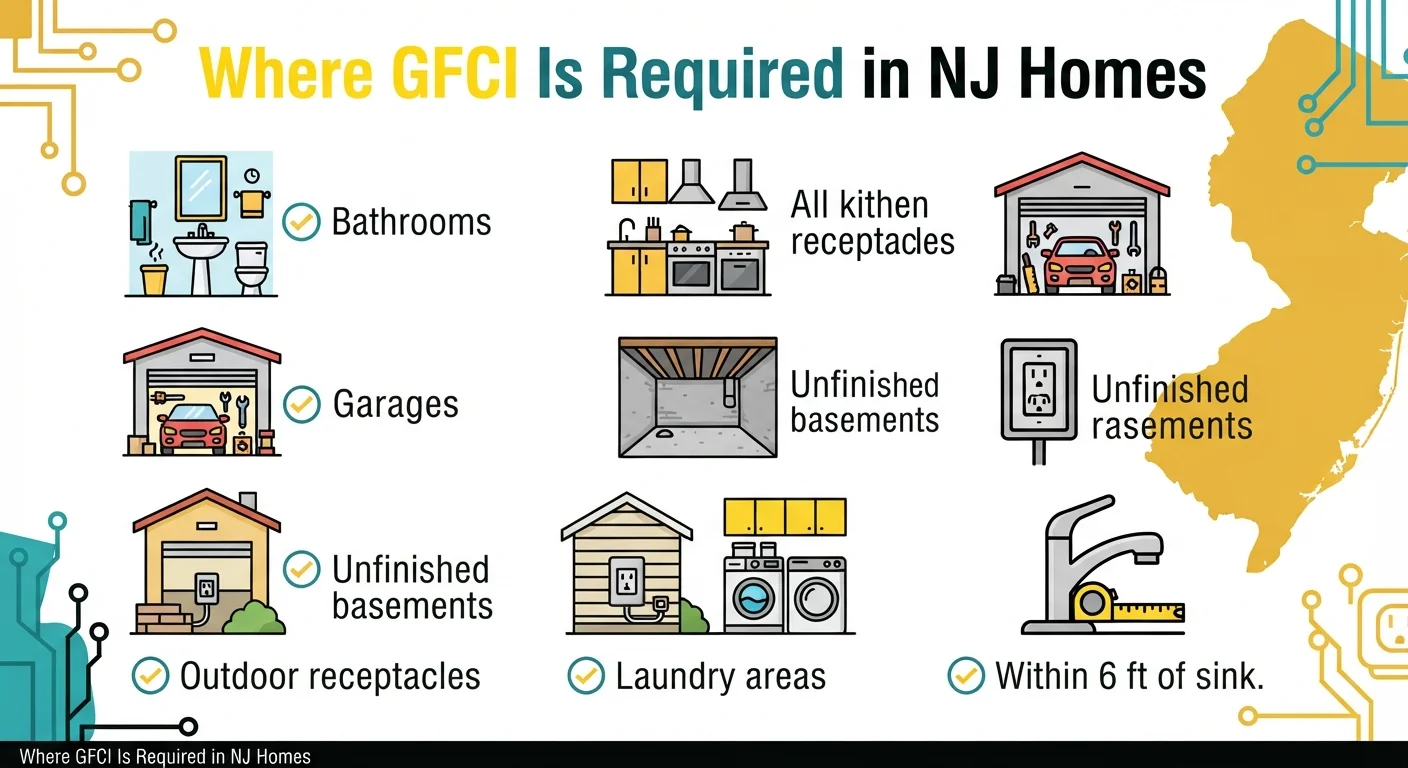
The list has grown steadily since 1971. In a modern dwelling it covers bathrooms, kitchens, garages and laundry areas. It also covers unfinished basements, crawl spaces at or below grade, and every outdoor receptacle.
The 2023 revision closed the gap that caused the most confusion. GFCI protection in kitchens used to attach to countertop receptacles. It now applies across the kitchen, including outlets serving an appliance within six feet of the sink.
Bathroom rules are tighter than people expect. A receptacle has to sit within three feet of the outside edge of each basin. It also has to be protected.
The 406.4(D) Trap in Older Shore Homes
Here is where a simple swap stops being simple.
Say the outlet beside your bathroom sink is a plain two-prong receptacle. It went in decades before the rule existed. You replace it with another standard receptacle. That looks like ordinary maintenance, and the DCA list does allow the replacement.
The condition attached to that allowance is the whole story. A receptacle in a location where GFCI protection is required must comply with 406.4(D). You cannot put a plain outlet back. The replacement has to bring that location up to current protection. In practice that means a GFCI device, or a GFCI breaker feeding it.
In our experience the older the house, the more often this comes up. Long Branch and Asbury Park hold a large stock of pre-1975 homes. Their bathroom and basement outlets predate every version of this rule. Owners assume like-for-like is legal because the outlet has worked for forty years. The code reads the other way.
The second trap is grounding. Many of those homes have two-wire circuits with no equipment ground. A GFCI can legally replace an ungrounded receptacle. It has to be labeled “No Equipment Ground.” It still does not create a ground for surge protectors. That labeling is part of the job, not an optional nicety.
Who Can Legally Do Which Job
| The job | NJ classification | Permit | Who may perform it |
|---|---|---|---|
| Failed GFCI replaced with a similar GFCI | Ordinary maintenance | None | Homeowner or handyman |
| Standard receptacle replaced in a bath, kitchen, garage or basement | Ordinary maintenance, 406.4(D) applies | None | Homeowner or handyman |
| Up to five new outlets added | Minor work | Required | Licensed electrical contractor |
| New circuit, new panel, or service change | Full electrical permit | Required | Licensed electrical contractor |
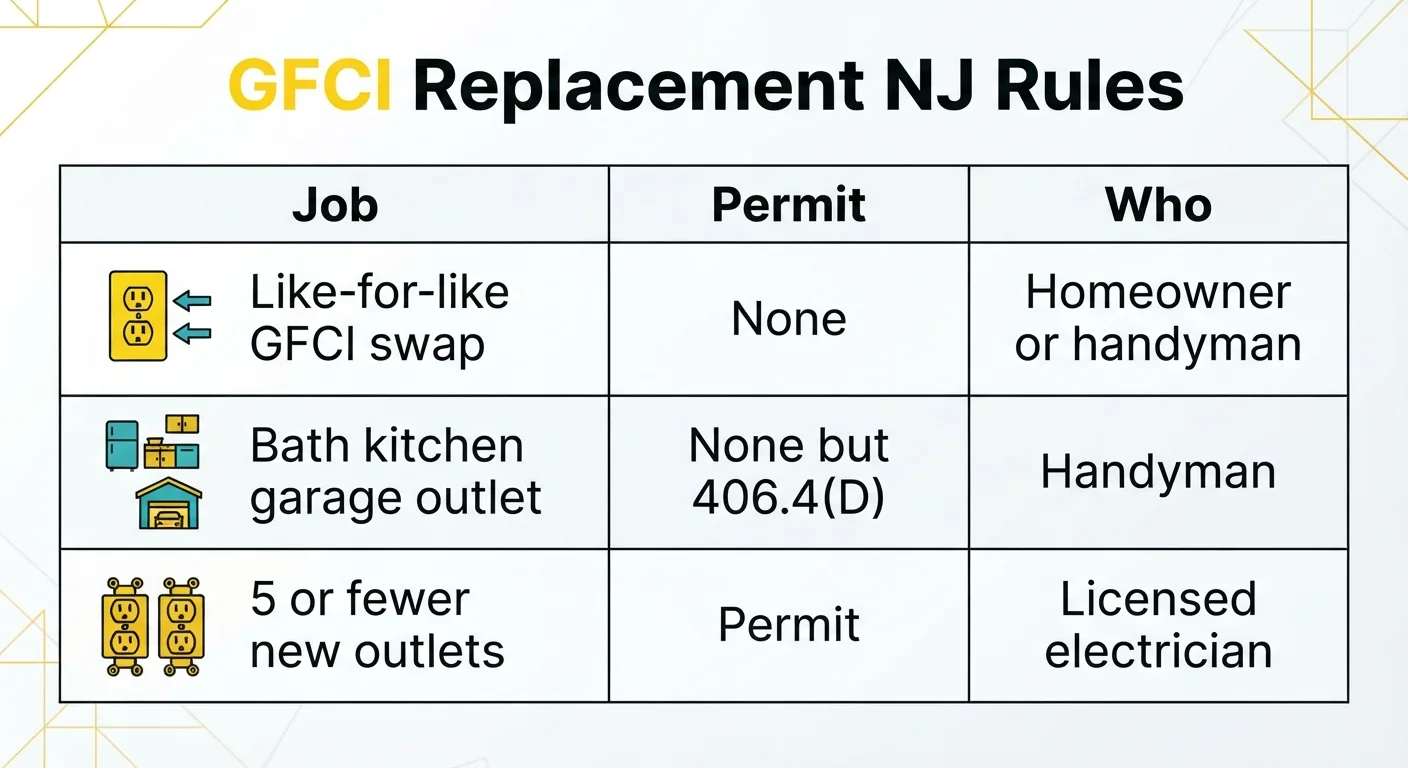
We handle the top two rows as part of general handyman electrical work. The bottom two go to a licensed electrical contractor, every time, without exception. That is not caution. It is what the license law says.
What We Check Before Touching the Device
A GFCI that trips constantly is often doing its job. Before anyone replaces one, four things are worth testing.
First, whether the trip is real. Press test, press reset, and see whether it holds with nothing plugged in. A device that will not reset while unloaded is either failed or seeing a genuine fault upstream.
Second, whether the outlet is a downstream slave. One GFCI commonly protects a whole string of ordinary outlets. Replacing a dead outlet at the end of that string changes nothing. The GFCI feeding it may have tripped out in the garage.
Third, moisture. Salt air corrodes outdoor receptacles and their covers faster than inland air does. That applies to any home within a few blocks of the water. Outdoors, the correct part is a weather-resistant device in an in-use cover. A standard indoor GFCI in a bubble cover is not.
Fourth, age. A GFCI is a mechanical device with a finite life. Manufacturers generally put that at ten years. Self-testing models built after 2015 refuse to reset when their internal test fails.
Why the Device Matters More Than the Price
The safety case here is unusually well measured. Between 1971 and 1980 the country averaged around 1,101 electrocutions a year. Between 2011 and 2020 that average fell to 246, and consumer product electrocutions fell from 491 to 41.
Studies put GFCI effectiveness at 81 to 95 percent in preventing electrocution deaths. Very few home safety devices are measured that favorably.
That is the argument for replacing a suspect one promptly rather than living with a nuisance trip. It is also the argument against the cheapest device on the shelf. Not comfortable pulling the device yourself? Our emergency electrical service covers it. So does a routine home repair visit.
Older homes tend to reveal other things at the same time. Loose backstab connections, painted-over outlets, and undersized boxes show up in the same walls. That is why we usually pair the swap with the wider electrical checks described here.
Fix It Before an Inspector Writes It Up
A missing GFCI in a bathroom, kitchen, garage or basement is a standard write-up. It is one of the most common items on a New Jersey inspection report. The correction is cheap and the argument at the closing table is not. Buyers ask for a credit, and the credit is rarely limited to the twenty dollars the device costs.
The same findings repeat across the county. Our pre-sale repair checklist collects them. Sellers in West Long Branch often handle the outlets in one visit. The smoke and carbon monoxide certification gets done at the same time.
That is sensible sequencing. Both are cheap, both are fast, and both stop a buyer’s inspector from writing a paragraph about them. If you would rather have the whole list checked at once, get in touch.
FAQ
Do I need a permit to replace a GFCI outlet in New Jersey?
No. Replacing a receptacle with a similar item is ordinary maintenance under the DCA list. No permit and no inspection apply. Adding new outlets is minor work and does need a permit.
Can a handyman replace outlets in New Jersey?
For like-for-like replacement, yes. Ordinary maintenance is open to a homeowner or a general contractor. New circuits, new outlets, and panel work require a licensed electrical contractor.
My bathroom outlet is not a GFCI. Can I just put the same type back?
No. A receptacle in a location where GFCI protection is required has to comply with 406.4(D) when replaced. The new device must provide that protection.
How long does a GFCI outlet last?
Around ten years is the common guidance. Coastal Monmouth County homes often see less, because salt air accelerates corrosion on outdoor and garage devices.
Why does my GFCI trip when it rains?
Usually water intrusion at an outdoor box or a corroded cover. That is the device working correctly. The fix is the enclosure and the gasket, not a new receptacle.
Sources
- NJ DCA, Significant Changes to Minor Work and Ordinary Maintenance
- NJ Division of Consumer Affairs, Board of Examiners of Electrical Contractors
- Electrical Contractor Magazine, Article 210 Branch Circuits
- CPSC, Economic Considerations for Ground Fault Circuit Interrupters
- ESFI, Ground Fault Circuit Interrupters
Need a hand with your home?
If you have a plumbing question or need to schedule a service call, our team is ready to help. We serve West Long Branch and communities across Monmouth and Ocean Counties, NJ.