Fall Home Maintenance Checklist for New Jersey Homes

Fall maintenance lists are usually written for the whole country. New Jersey does not need that list. The Jersey Shore has its own failure order, and it is fairly predictable.
Salt air works on exterior metal all summer. The first nor’easter arrives before the heating system has been run. Leaves drop late here, often into December, which throws off every gutter schedule copied from a national guide.
Key Takeaways
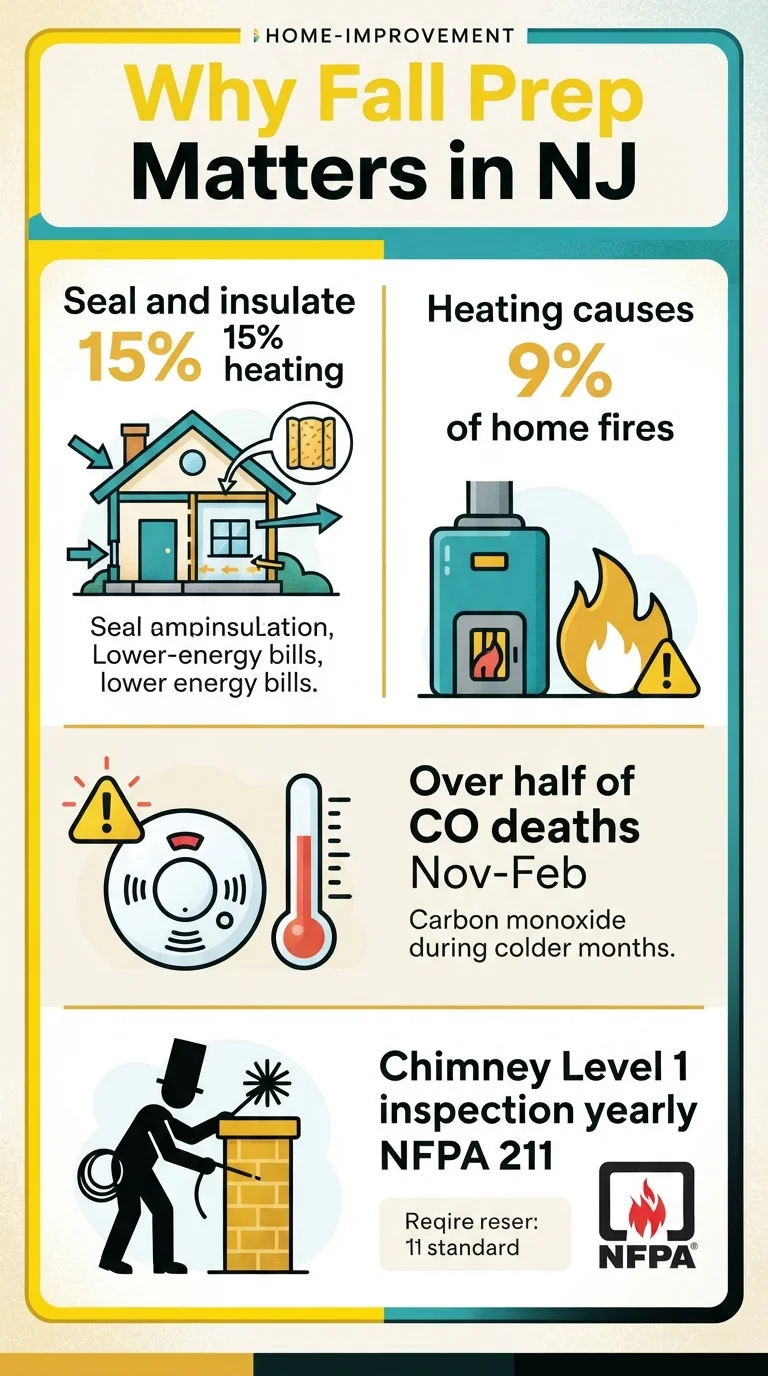
- Sealing air leaks and adding insulation saves an average of 15 percent on heating and cooling costs, or about 11 percent of a total energy bill.
- Heating is the second leading cause of residential building fires, at 9 percent of the total.
- More than half of carbon monoxide deaths fall in November through February, which is exactly the window this checklist prepares for.
- Chimneys and vents should get a Level 1 inspection every year under NFPA 211, whatever fuel they burn.
- Do the outdoor work first. Sealing, caulking and paint all need temperatures that New Jersey loses in mid-November.
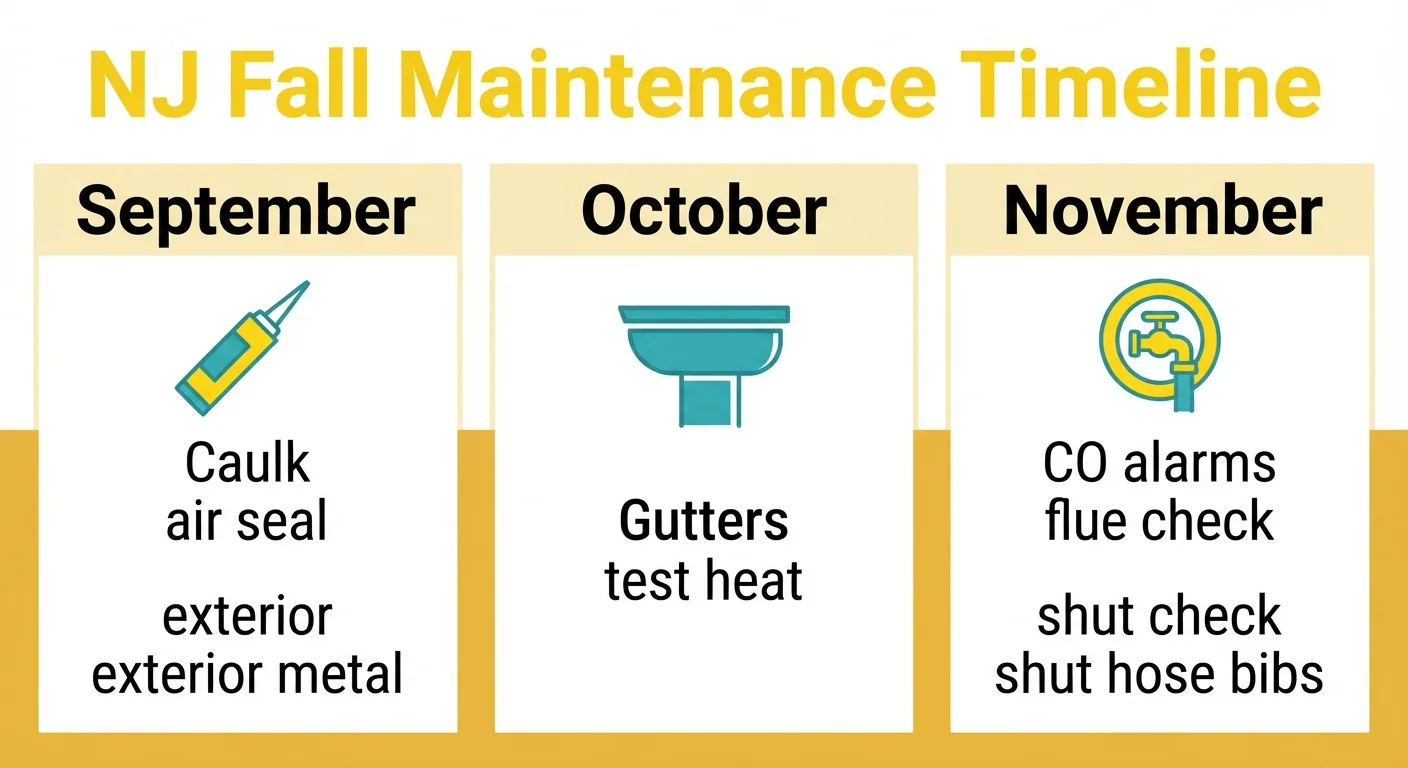
September: Everything That Needs Warm Weather
September is not early. It is the only month where exterior sealants cure properly and a ladder is still pleasant.
Start with the envelope. Caulk, weather stripping and exterior paint all have minimum application temperatures. Most acrylic-latex caulks want 40 degrees and rising. Wait until November and the product will go on, then fail by February.
Air sealing is the highest-return item on this list. The EPA puts the savings from sealing and insulating at 15 percent of heating and cooling costs. On a shore home with an unconditioned crawl space, it usually runs higher.
Check the attic hatch, the rim joist, and every penetration where a pipe or wire leaves the house. Those three account for most of the leakage we find. The full method is in our guide to weatherproofing windows and doors.
Then look at exterior metal. Salt does its damage between June and September. Hinges, storm door closers, railings, hose bibs and light fixtures all corrode faster within a mile of the water. Free them and lubricate them now, while they still move.
October: Water, Then Heat
October is gutter month, with a caveat. Oaks and maples in Monmouth County hold their leaves well into November. Cleaning gutters on October 1 means cleaning them twice.
The better sequence has two passes. Clear the downspouts and test the drainage in early October. Do the full clearing after the leaf drop finishes. What matters in October is that water leaving the roof has somewhere to go.
Check where the downspouts discharge. Water dumped at the foundation is the leading cause of the wet basements we get called about in January. Extensions are cheap. Interior water damage is not. We covered the tradeoffs in professional gutter cleaning versus DIY.
Heating comes next. Run the system in early October, before you need it. A furnace that will not light on a 60 degree day is an inconvenience. The same failure on the first 25 degree night is an emergency call at emergency rates.
In our experience, most first-run failures are small. A dirty flame sensor, a seized inducer motor, a filter nobody changed since March. All of them are cheaper in October. The schedule we work to is set out in our heating maintenance guide.
November: Fire, Air and Water Lines
Heating equipment causes 9 percent of residential building fires. That makes it the second leading cause overall, behind cooking.
Two checks address most of that risk. First, clear everything combustible within three feet of the furnace, boiler or space heater. Storage creeps toward the heat source over the summer. It always does.
Second, the flue. NFPA 211 asks for a Level 1 inspection every year, for soundness, deposits and clearances. That applies to gas appliances too, not only wood.
Carbon monoxide follows the same calendar. More than half of CO deaths occur in November, December, January and February. New Jersey requires working smoke and CO alarms. The Division of Fire Safety uses the clock change as the reminder to test them. That is a reasonable date to use.
Outdoor water lines are the last November item. Shut the interior valve feeding each hose bib. Open the exterior spigot. Drain it, then leave it open through the winter.
A frost-free sill cock still splits if a hose is left attached. The hose holds water against the valve seat. That single mistake causes more burst pipes than any other on our plumbing calls.
Crawl Spaces and the Moisture Nobody Looks At
Fall is when crawl space problems start, and spring is when people notice them.
The mechanism is simple. Ground temperature stays fairly steady while the air above cools. Warm, humid air moving through a vented crawl space meets cool surfaces and condenses. Ducts, joists and subfloor all collect water.
Left alone through the winter, that moisture shows up upstairs. Musty air first, then cupped hardwood, then rot at the band joist. It rarely announces itself until the damage is done.
The fall check takes ten minutes. Look for standing water, damp insulation hanging loose, and any vapor barrier that has drifted out of place. Batt insulation sagging out of the joist bays is the most common finding. It means the floor above has been uninsulated for some time.
Fixing the vapor barrier and re-securing insulation is straightforward work. Doing it in September is far more pleasant than doing it in February.
What Not to Bother With
A fall list should also say what to skip.
Do not have the ductwork cleaned as routine maintenance. In a house without a specific problem, there is no evidence it improves air quality. It is one of the more oversold seasonal services.
Do not replace a working water heater because it is old. Test the temperature and pressure relief valve. Drain a few gallons of sediment, and check the anode if it is accessible. Age alone is not a fault.
Do not seal a house tighter without thinking about ventilation. A well-sealed home still needs bath and kitchen exhaust that actually vents outside, not into the attic.
The Order That Actually Matters
| Window | Task | Why this window |
|---|---|---|
| Early September | Caulk, weather strip, exterior paint | Sealants need 40 degrees and rising |
| Mid September | Free and lubricate exterior metal | Salt corrosion peaks after summer |
| Early October | Test downspouts and drainage | Before the first heavy rain |
| Early October | First run of the heating system | Repairs are cheaper before demand |
| Early November | Clearance and flue inspection | Ahead of continuous heating |
| Mid November | Drain and isolate hose bibs | Before the first hard freeze |
| Late November | Final gutter clearing | After the leaf drop finishes |
The order is the point. Every one of these tasks is easy in isolation. Doing them out of sequence is what turns a checklist into a wasted weekend.
What Shore Homes Need That Inland Homes Do Not
Three things separate a coastal fall list from a generic one.
Corrosion is the first. Fasteners, hinges and light fixtures fail faster near the water. Stainless hardware is worth the premium on anything exposed.
Crawl spaces are the second. A large share of older Monmouth and Ocean County homes sit over vented crawl spaces. Fall is when the temperature differential starts driving moisture through them.
Storm readiness is the third. A nor’easter arrives with wind and rain together, and it does not respect the calendar. Loose trim, an unsecured storm door and a lifted shingle are all cheap to fix in September. In a January storm they become the reason water gets in.
Homeowners tell us the same thing every spring. The repair they regret is never the one they did early. Want the exterior looked at as one job? Our general home repair service covers the whole list. You can also book a visit.
FAQ
When should fall maintenance start in New Jersey?
Early September. Exterior sealants, caulk and paint need temperatures above roughly 40 degrees and rising. The shore loses that reliably by mid-November.
Should I clean gutters in October or November?
Both, in effect. Clear the downspouts in early October so water can drain. Do the full clearing after the leaf drop ends in late November.
Does a gas fireplace need an annual chimney inspection?
Yes. NFPA 211 calls for a minimum Level 1 inspection every year. That covers all chimneys, fireplaces and venting systems, regardless of fuel.
Why do outdoor faucets burst even when they are frost-free?
Usually because a hose was left attached. The hose traps water against the valve seat, past the frost-free section. That trapped water freezes and splits the pipe.
How much can air sealing actually save?
The EPA estimates an average of 15 percent on heating and cooling costs, or about 11 percent of a total annual energy bill.
Sources
Need a hand with your home?
If you have a plumbing question or need to schedule a service call, our team is ready to help. We serve West Long Branch and communities across Monmouth and Ocean Counties, NJ.